Loch Lomond's Milarrochy Bay to Loch Ard |
Loch Lomond is 22.6 miles long and just over 5 miles wide at its broadest point and sits in a glacially eroded basin, surrounded by hills/mountains on all sides. The tallest being Ben Lomond, at 3,195 foot tall and which can be seen near to the eastern shore of the loch. Loch Lomond has a surface area 113 square miles and is the largest body of freshwater in Great Britain. The loch also measures around 620 foot at its deepest point and contains over 30 small islands dotted around within it. With the biggest being called "Inchmurrin", which is the largest fresh water island in the whole of the British Isles. |
|
 |
|
But perhaps the most well known thing about Loch Lomond, is not the loch itself, or the area that surrounds it. But a 300 year old love song, called "The Bonnie Banks o' Loch Lomond". Which if you are one of those rare people, who has never heard this song before? Or you just want to remind yourself of what it sounds like, then click HERE. Setting the scene: It is thought that the "Loch Lomond" song, dates back to the early 16th century, where it is said in ancient Celtic mythology, that the "low road" was a fairy route for a soldier's soul to return home, when killed in battle. Even though the song has since been associated, with the Jacobite rebellion of 1745/6. After Bonnie Prince Charlie begun to realise, that his Jacobite army, was never going to be strong enough, to reinstate him as the rightful heir to the combined thrones, of England and Scotland. So had retreated back to Scotland with his battle weary soldiers, to decide what they could do next. |
|
 |
But which ultimately led to his defeat, at the Battle of Culloden. When the British Army, who had been able to quickly track them down, defeated what remained of the Jacobites in one final battle. And where the Loch Lomond song, took on a new and deeper meaning. After a story emerged, of a battle survivor, who was about to be executed for treason. Where it is said that his wife was waiting for him in the crowd next to the gallows and how he began to sing to her as he passed by. Telling her how their love was so strong, he knew his spirit would soon return to her. After she had travelled home on the high road and he the Fairy road below. O ye'll tak' the high road, and I'll tak' the low road,
|
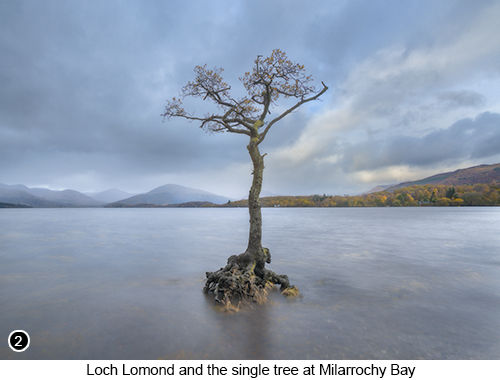
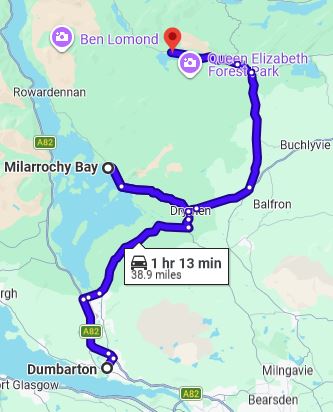
So if you want to look at this full route on Google Maps, then click on the map to the right, to load the full route into your browser - but I am also going to describe the route in full anyway, just to make sure you get here. From Dumbarton, head towards the A82, the Trossachs and the Loch Lomond National Park, until you reach a roundabout that meets with the A811 to your right, signposted for Stirling and Balloch and take this turn from the roundabout, Street View, Map View. Then continue driving along the A811, until you reach a second roundabout, with a sign to the Loch Lomond Shores pointing to your left. But keep driving straight on, along the Loch Lomond road, Street View, Map View. Then keep going on the A811, until you see a turning on your left heading towards the village of Drymen and the B858. Take this left hand turn, Street View, Map View. Now continue driving up this road for a little way further. Until you reach another left hand turn along the A837 and the road to the village of Balmaha, Street View, Map View. And take this left hand turn. You will now be driving up a single track unnamed road, until you drop down a short hill and where you will then see a left turn into the Milorrochy Bay Car Park, Street View, Map View. Turn in here and park wherever you can - this car park also has toilets and shower facilities, that remain open all year round. Then walk to the front of the car park and the edge of Loch Lomond, where you will then see the single tree, standing in the water just in front of you, as shown in SHOT 2 above, Street View. Tip 1: Even though all three shots from Milorrochy Bay, I am showing you above and below. Were taken within a few yards of the car park and very easy to get to. |
 |
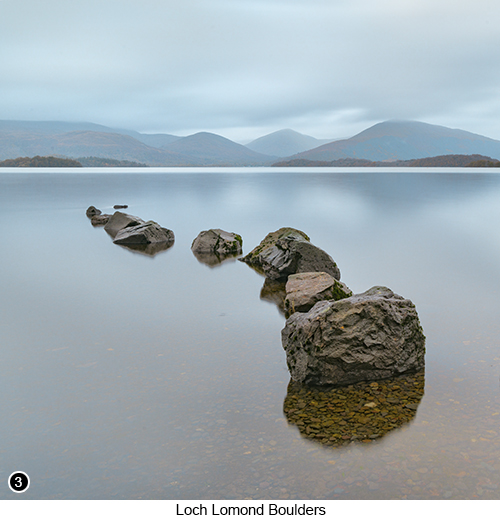 |
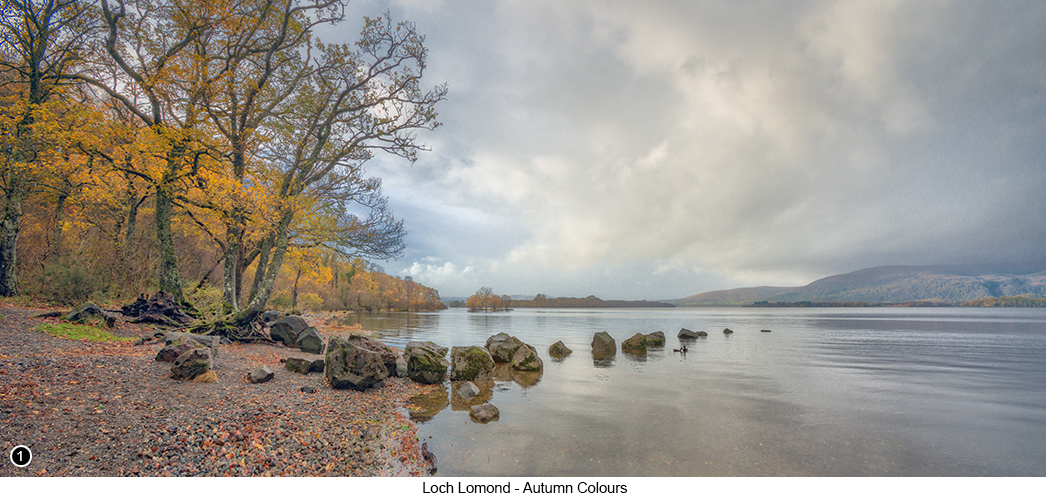
These are still not easy shots to get throughout the day. Unless you are here well before the crowds start to turn up. As Milarrochy Bay, is a very popular area for Jet Skiing, kayaking and wild swimming etc. So if you want a clean shot of these scenes, without ripples and people all over it, then you must be here early, or prepared to work in bad weather, when everyone else has chosen to stay at home. For SHOT 1, I stepped over the low metal barrier, at the top end of the car park and walked down the pebbly beach, to the edge of the loch and the single tree in the water. I then carried on a little further over to the left. To setup and shoot, a wide pano view of the scene to my left. That I hoped would capture all those lovely autumn colours, as well as a much wider view of Loch Lomond from Milarrochy Bay. I then walked back over to the single tree (as this was the view I was really there to capture), to work on that scene for a while and to get the old creative juices flowing. Which I continued to do for several more minutes. Until a group of mature ladies in bathing costumes, holding flotation devices attached to their wrists. Started to shiver their way out into the loch, for a bit of wild swimming. Well I say wild swimming. As they seemed more intent on standing there shivering, waist deep in the loch, discussing all the scandal that was happening in their neighbourhood. And who seemed oblivious to the fact, that sound can carry so clearly over calm water. To the point, where their voices sounded to me, as if I was standing in the middle of their group. So trying to blank them out and keep my mind on the task. I continued to photograph the single tree and chat to the occasional dog walker, as they came by and then took a shot of my chosen view with their mobiles - does this happen to you? Because it happens to me a lot. Yet all I could hear from the group of ladies in the loch, was who was doing what to who and how they should be ashamed of themselves etc. So having finally got the shot of the single tree in the bag, as shown in SHOT 2 above and wanting to get away from the scandal and laughter. I walked back to my left to the boulders in the edge of the loch, where I setup for SHOT 3, as shown here to the left. |
OK, I know I am making these three shots shown above sound easy. But believe me none of them were, if you take into consideration, how many times I had been to this location, over a two year period and how I had previously failed miserably every time. Yet on this day, the gods of photography were smiling down on me and everything seemed to be working in my favour. Even when I moved onto the next location in this short guide, to Loch Ard. Where the weather kept doing exactly what I wanted - AMAZING! Tip 2: To get any of the three shots shown above, to look similar to what you see here. Then you need be here when Loch Lomond is full. Which means, as Loch Lomond is a freshwater loch, the level of its waters, are not dependant on the height of the tides. Therefore if you want the single tree shot shown in SHOT 2 above, to be standing with its roots surrounded by water. You need to plan be here, after it has been raining heavily for several days, if not weeks. But as we get much more than our fair share of bad weather up here in Scotland, then low water levels in the loch, is rarely a problem over the colder months. But is something that can happen, during the summer. |
|
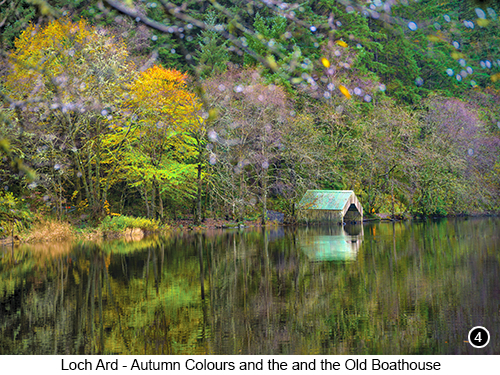
Loch Ard - Scottish Gaelic: Loch na h-Àirde, where the word "Àirde" means high point. Is another loch, that is located within the Loch Lomond and Trossachs National Park. But is considerably smaller than Loch Lomond. At just over two and half miles long and one and a quarter miles wide, at it widest point. But this smaller loch, is also surrounded by hills on all sides and so the waters at its upper end (which is the location I am showing you here), tend to fall calm and reflective, even when the surrounding area is quite windy. So a really great location for getting some of those reflection shots, that we all love to take. As shown to the right and below. But even better, is that Loch Ard has an old wooden boathouse, that sits on the opposite side to the loch from where you will be shooting and which I have included into all three of the following shots. Simply because this little boathouse, is just so photogenic and easy to add into your compositions. As shown in SHOT 4 to the right. How to get there - Loch Ard: So having captured all your shots of the Milarrochy Bay area of Loch Lomond. Make your way back the same way you came in and back to the village of Drymen. Then turn left along the B585, until you once again rejoin the A811 and the Stirling Road. But now turn left towards Stirling, Street View, Map View. Then continue heading North, until you reach a junction, where the road then turns into the A81 and the A811 turns off to your right. So keep straight ahead, along the road that has now become the A81, Street View, Map View. Keep driving along the A81, until it comes to a roundabout, with the A821 heading towards Aberfoyle on your left. Take the A821 to Aberfoyle, Street View, Map View. |
|
|
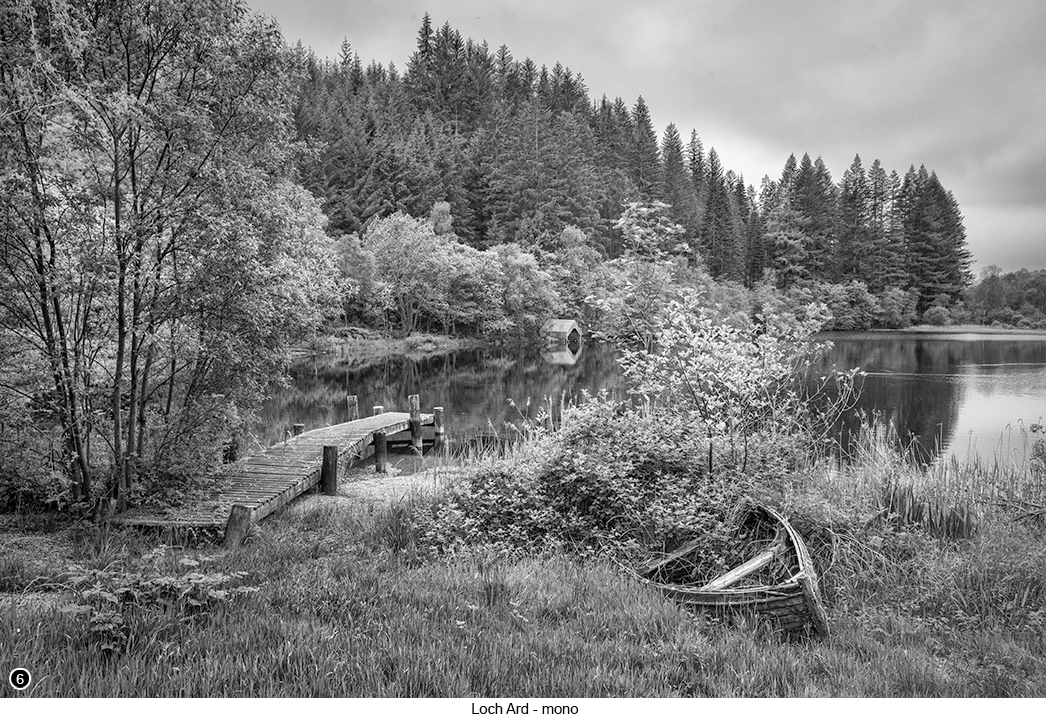
Now keep driving along the A821 towards the village of Aberfoyle, then straight through the village, onto the Lochard road and the B829 and Kinlochard 4.5 miles further on, Street View, Map View. So continue on the B829 for a few more miles, until you are driving through the tiny village of Milton, with a view of Loch Ard and the old wooden boathouse on your left. As shown in SHOT 6 below, Street View, Map View. Unfortunately, there is absolutely nowhere to park in the village of Milton, So you will either have to do what I did and get your partner to drop you off and pick you up later. Or park outside of the village and walk back in. The nearest parking location of which, is shown here, Street View, Map View. Which is good couple of miles further on past the village, but which is also a very pleasant stroll alongside Loch Ard, all the way back into the village of Milton. Where you can then concentrate on taking your version, of the three views I am showing here and throughout the second part of this chapter. |
|
|
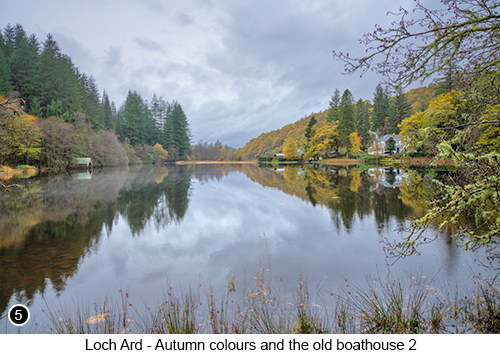
For SHOT 4 shown above, I walked past the main view (the view you will probably want to shoot first, as shown in SHOT 6 below), to the left of it and to a small area of grass, with a muddy path, leading into the woods next to the loch. The rain had been falling heavily, right until the moment I got out of the car and so the branches of these shrubby little trees next to the loch, were still dripping with rain. And which seemed to sparkle in the light, which of course I promptly ignored. As I began to move around the trees, looking for a clean shot through to the boathouse and the tree with the autumn colours to the left of it. But there just wasn't a wide enough gap to shoot through the trees, without having branches sticking into the edges of the frame. So I stood back and looked at the scene again and thought, "OK, if I can't get what I want, due the clutter of branches? Then why not incorporate them into the shot. And better still, if I shoot the scene fully wide open at f/2.8, with the branches and water droplets, as near to the front element of my lens as I could. I may be able turn these colourful droplets, into little diffused, glowing blobs of bokeh (out of focus bits). That might even add some lighter elements, into darker parts of the scene. And which turned out amazingly well in my humble opinion. As shown in SHOT 4 above. I then moved around the trees a little more, looking to see if I could find a different angle of the scene. Until I found a relatively clear view, down through the middle of this upper part of the loch. As shown in SHOT 5 to the left. |
I then wandered my way back to where I started and what I considered to be the main view of this shoot and the scene, I had really come here to capture. As shown in SHOT 6 below. Which I then turned into monochrome (because I like mono OK?), to emphasise the detail, as well as highlight the various bits of interest within it. Which I hope you will agree, has lots of things to attract the viewers eye. Such as the little wooden jetty, that leads your eye out into the scene and across the loch to the boathouse. Then over to the right following the reflections. Then back down to the abandoned old wooden boat in the foreground, with the grasses growing through it. Then back to the jetty etc. In my experience, it is very rare to find a composition, that is uncluttered yet so full of interest and easy to take, standing at the side of the road. But this is definitely what you will find, if you come here to shoot at Loch Ard with your camera. And due to limited (as in nonexistent) parking. You will probably have it all yourself. | |
|
|
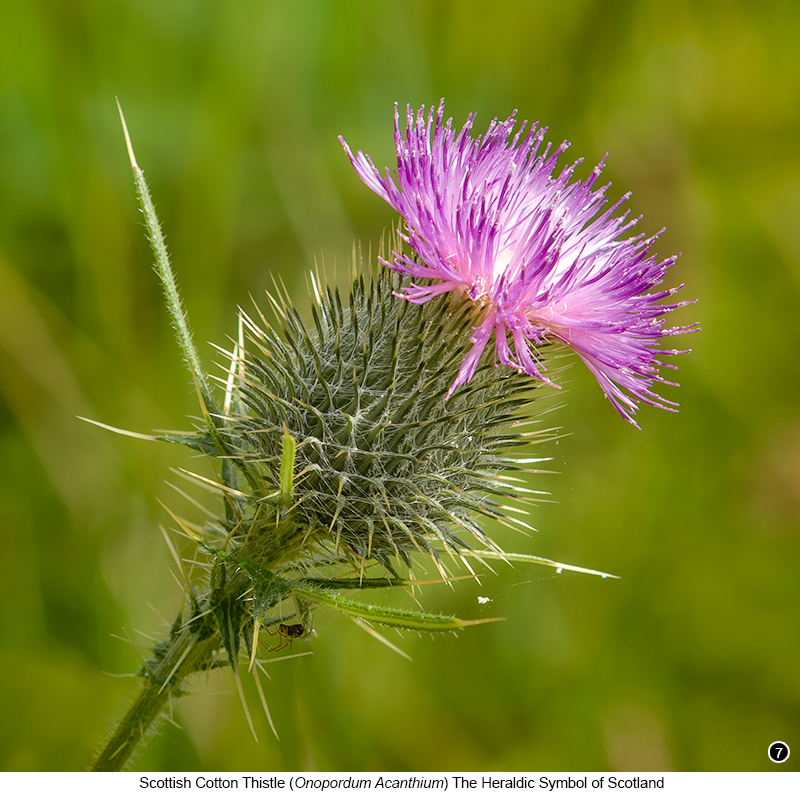
I then set off walking up the side of the loch, heading back to where my other half was waiting for me, in the lay by up the road, avidly reading the latest Stuart MacBride novel - she is totally addicted to these books by the way and very good page turners they are too. Where I came across this single flowering Cotton Thistle, at the side of the road, as shown in SHOT 7 below. Which I thought was unusual, as they normally flower in late September. But here it was at the beginning of October. Yet I knew as soon as I saw it, that I needed to photograph it, so I did with my 70/200 and here is the result. But what really interests me now when I look at this shot below. Is how the spider at the bottom of the picture, has been clever enough to intricately thread its web, all the way around the body of the thistle and its spines, from top to bottom. Thereby turning the majority of this wildflower, into a three dimensional trap - AMAZING!!! Ah the beauty and savagery of nature..! |
|
|
|
Exif information for each of the numbered shots shown throughout this chapter --1 - Canon EF16-35/2.8L USM, 1/40 sec, f/16, ISO 200, Focal Length 16mm (cropped into a pano), taken on 1st Nov 08:41 --3 - Canon EF16-35/2.8L USM, 30 Sec (with 10 sop ND filter), f/16, ISO 200, Focal Length 35mm, taken on 1st Nov at 09:15 --4 - Canon EF16-35/2.8L USM, 1/400 Sec, f/2.8, ISO 200, Focal Length 16mm, taken on 11th Oct 08:41 --5 - Canon EF16-35/2.8L USM, 1/50 Sec, f/13, ISO 100, Focal Length 18mm, taken on 1st Nov at 08:47 --6 - Canon EF16-35/2.8L USM, 1/100 Sec, f/11, ISO 400, Focal Length 28mm, taken on 11th Oct 09:21 --7 - Canon EF70-200/2.8L IS USM, 1/400th Sec, f/2.8, ISO 320, Focal Length 200mm, taken on 2nd Oct at 11:22
Please Note: Even though I describe this "Loch Lomond to Loch Ard shoot" above, as though I shot the entire thing over just a few hours, I didn't. But in fact shot it over several separate visits, a few weeks apart. So I am simply trying to describe this as a single "One Stop Walk though" photo shoot, to better guide you from one location and scene to another in one go. As I am sure you wouldn't want me to bore you with unnecessary details, about how I first came here scouting for shots. Grabbed one or two, before driving home to come back a couple of times later, when the conditions were more like what I wanted. Hence the reason for the gaps between dates, shown in the EXIF data above. |
|
If you have enjoyed reading these 'Extra' chapters to my Guide Book and think you might also enjoy reading 79 more chapters across 270 pages, that also includes more than 340 Fine Art quality images, along with detailed descriptions and large scale maps to guide you to the exact location of where I took each and every one of them and which then goes onto discuss the techniques and tools I used to process them, but where everything is written in plain easy to understand English? Then please consider buying the Book. |
 |
 |
|